Stripes are bold, classic, and surprisingly easy to make your own. A striped T-shirt can feel relaxed with jeans, crisp under a blazer, or playful tucked into a bright skirt. Yet this familiar print still comes with one stubborn rule: horizontal stripes supposedly make everyone look wider, while vertical stripes always make everyone look taller.
That is a lot to ask of a few lines. The way a striped garment looks depends on its cut, fabric, color contrast, spacing, and fit, as well as what you wear with it. You do not need to avoid your favorite print because of a blanket rule. Let’s separate the myth from the useful styling advice.
Myth: horizontal stripes are always unflattering
The problem with this claim is the word “always.” A close-fitting ribbed top with broad stripes behaves differently from a loose cotton shirt covered in fine lines. Even two tops with the same stripe pattern can look quite different if one has dropped shoulders and the other has a neat shoulder seam.
The original enthusiasm for stripes often rests on optical illusions: lines can influence how we perceive a shape. But an illusion on a flat surface is not a promise about every garment on every person. Clothing folds, stretches, and moves. There is no reliable shortcut that makes horizontal stripes universally widening or universally slimming.
More importantly, “flattering” does not have to mean appearing smaller. It might mean a neckline you love, a comfortable fit, or a color combination that makes your outfit feel alive. Try the garment on before letting the direction of its stripes decide for you.
Start with fit, then consider the lines
When trying on a striped top, check the shoulders, chest, and hem first. If you want a smooth fit, look for enough room that the fabric rests against you without pulling. Stripes that bend sharply around a button placket or stretch unevenly across the chest can help you spot tension in the garment.
Move around, sit down, and raise your arms. A top that only looks right when you stand perfectly still probably needs a different size or cut. For an oversized style, make sure the volume feels intentional: a generous shirt can work beautifully with straight trousers, while a loose tee can be partially tucked into jeans.
Check the hem length, too. A striped top ending at the waist creates a different proportion from one reaching the upper thigh. Try a full tuck, a small front tuck, and an untucked version. These quick adjustments often change the outfit more noticeably than switching stripe direction.
Stripe width and contrast change the mood
Fine stripes tend to read as a quieter pattern from a distance, especially when the colors are close together. Think pale blue with white, charcoal with gray, or cream with soft brown. These combinations are useful if you enjoy prints but want something easy to pair with the rest of your wardrobe.
Wide, high-contrast bands make a stronger statement. Black and white, navy and cream, or a vivid color against a pale background can become the main feature of an outfit. Give that feature room by choosing simple accompanying pieces rather than feeling obliged to add more decoration.
Look at where the bands fall, particularly on dresses. A contrasting stripe near the waist or hem naturally draws attention to that area. There is no forbidden placement; the question is whether you like the overall effect. View the whole outfit from a few steps away instead of judging one section in the mirror.
Choose fabric for the shape you want
A cotton jersey tee is a useful everyday starting point. A medium-weight version often holds its outline more clearly than a very thin, clingy knit. Check lighter stripes in good light to see whether you are comfortable with the fabric’s opacity, and choose smooth underwear if you prefer an uninterrupted finish.
Ribbed knits stretch with the body, so their stripes may widen or curve when worn. That can be part of the look, but try the piece on rather than judging it on a hanger. A fluid woven fabric gives striped skirts and dresses movement, while crisp cotton makes a striped shirt feel more structured.
For tailored pieces, inspect the seams and closures. Stripes meeting neatly at a prominent seam can create a tidy finish, although some designs deliberately change direction. Follow the care label after purchase, and reshape washable knits gently so the garment keeps the silhouette you chose.
Three easy outfits built around a striped top
- A relaxed everyday outfit: Pair a navy-and-cream striped tee with straight-leg jeans and white trainers. Add a tan belt if you tuck in the top. On a cooler day, an open denim jacket brings another layer without requiring a new color palette.
- A polished work outfit: Wear a fine-striped cotton shirt with solid tailored trousers and loafers. Tuck the shirt in fully for a defined waist, or choose a shorter, straight-cut shirt to wear untucked. A plain blazer keeps the combination easy to repeat.
- A colorful weekend outfit: Try a black-and-white striped top with an olive, red, or cobalt skirt. Keep shoes simple and repeat one existing color in your bag. The stripes provide a clear pattern while the skirt supplies the color.
Use these as starting points, not formulas. Swap trainers for ankle boots, trousers for comfortable wide-leg pants, or a blazer for a cardigan according to your day. The goal is an outfit you can actually wear.
Make a striped dress work beyond one occasion
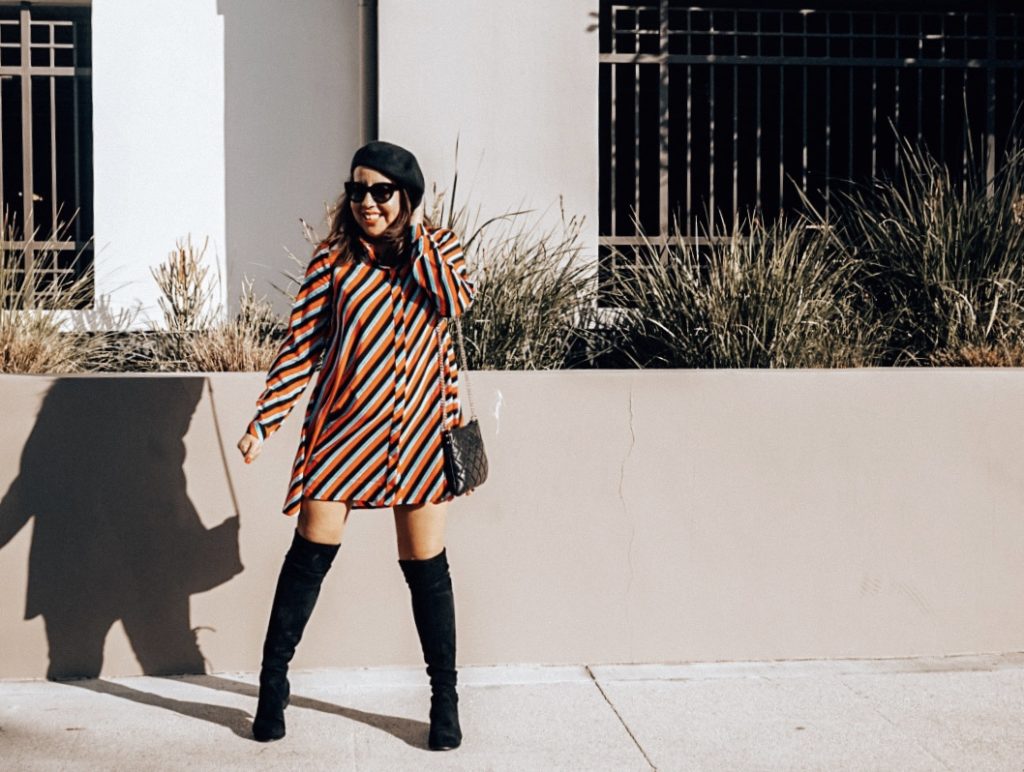
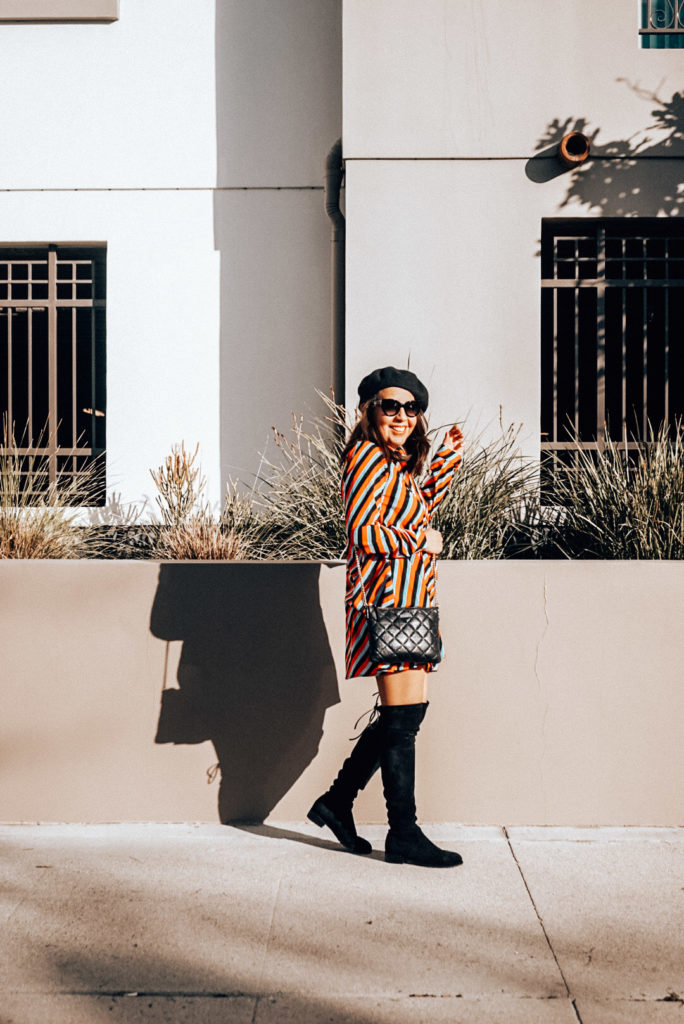
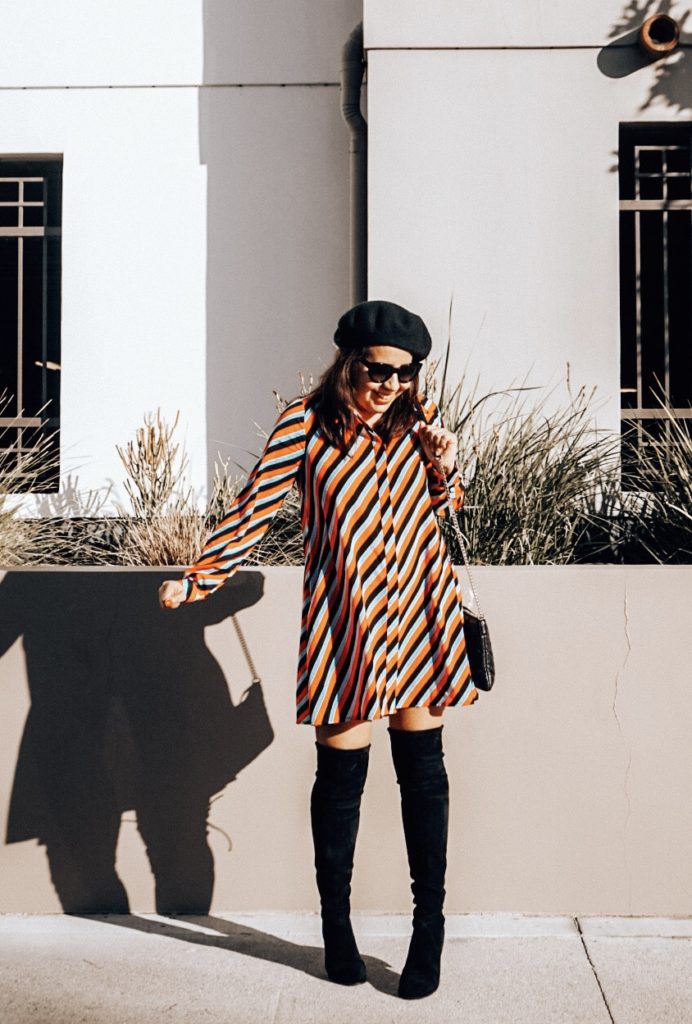
A striped dress already has plenty of visual interest, so begin with minimal accessories. For a casual day, try flat sandals and a soft tote. For a more dressed-up setting, add a solid jacket, simple earrings, and loafers or heels you can comfortably walk in.
If you want waist definition, test a narrow belt without pulling the fabric into heavy bunches. If the dress is designed to hang loosely, you may prefer its original shape. An open shirt or jacket can introduce vertical edges around horizontal stripes, but that is an optional styling detail rather than a correction your body needs.
Mix patterns with one clear connection
Stripes can sit happily beside florals, checks, or another stripe. Start with two patterns that share a color: a navy-striped top and a floral skirt with navy in its print, for example. Then vary their scale. Fine stripes beside a larger floral usually give the eye a clearer distinction than two equally busy patterns.
If that feels like too much, use a patterned scarf or bag with a striped top and plain bottoms. Keep jewelry uncomplicated while you decide whether you enjoy the combination. You can also try stripes in different directions within one garment, allowing its design to do the mixing for you.
The reality: your preferences matter most
There is no need to replace one rigid rule with another. Horizontal stripes do not guarantee a particular silhouette, and vertical stripes are not a requirement for looking put together. Good fit, comfortable fabric, and proportions you enjoy give you much more useful information.
Start with one striped piece you already like, build a simple outfit around it, and experiment with a tuck, a layer, or a different shoe. Stripes have staying power because they offer so many possibilities. Wear the version that feels like you.